As an Amazon Associate, I earn commission from qualifying purchases.
Welcome to Spain! The stage from Caminha to Viladesuso is the first complete stage on Spanish soil and presents the start of the second half of the Portuguese Camino de Santiago. Pastel de natas, bakeries, and café culture are in the past now. Time to say hello to tapas, Spanish Omelette, and empanadas!
A note to all of you Spanish speakers, don’t be alarmed if you don’t understand the people here. Many people (or Galegos) here speak their local dialect of Galician instead of Spanish.
With views of the coast that keep getting more and more beautiful, this stage is a great introduction to the Spanish section of the Coastal Route.
In Spain, the Camino Portugués goes north towards the city of Vigo, after which it connects with the Central Route in Redondela. This is still a few beautiful days away, though!
Save it for later! ↓

Quick links:
- Coastal Route Overview
- Yesterday’s stage: Viana do Castelo to Caminha
- Tomorrow’s stage: Viladesuso to A Ramallosa
Stage Overview
Experience Today’s Walk
☑ See Northern Portugal when you look back after crossing the Mino River
☑ Taste your first tapas of the trip
☑ Hear Buen Camino instead of Bom Caminho!
☑ Touch the weathered statue of Saint James at Fedorento Beach
☑ Smell fresh seafood coming from the many restaurants surrounding the A Guarda harbor
With a distance well below 20 km, today’s stage is a relatively short, relaxing walk beside the sea that seems to have been designed with the pilgrim in mind. Everywhere you go, the trail is well marked and the yellow arrows are easy to find. You’ll even find a rest area specially made for pilgrims!
After crossing the river Minho into Spain and the short walk into A Guarda, the first stage heads north past beaches, rocky shorelines, and some of the most stunning coastal scenery of the entire Coastal Route.
In Spain, the Coastal Route has more elevation and you’ll have to climb a few minor hills today. While none of them are particularly challenging, don’t be surprised when you feel tired at the end of the day.
On today’s stage from Caminha to Viladesuso, you’ll walk past some of the most photographed places of the entire Portuguese Camino. Keep your camera ready!

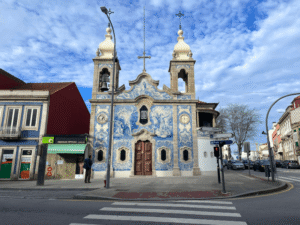
Exterior of the Igreja Matriz de Caminha on the Coastal Route 
Small camino shell fixed to the corner of a house in Caminha 
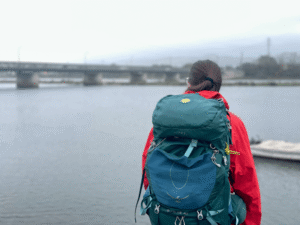
A pilgrim walking towards Fedorento beach outside A Guarda on the Coastal Route of the Camino Portugués 
Looking back at A Guarda and Fedorento beach on the Coastal Route 
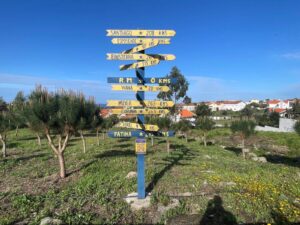
Camino marker on the Spanish coast on the Camino Portuguese 
Statue of Saint James on Fedorento beach on the Camino Portuguese 
Giant Camino shell next to the Camino Portuguese 
Fishing nets along the Spanish coastline 
A pilgrim walking next to the rocky coastline in Spain on the Portuguese Camino de Santiago 
The Royal Monastery of Santa María de Oia along the Coastal Route of the Camino Portugués 
Sunset from Viladesuso on the Coastal Route of the Camino Portugués
Taking the Water Taxi from Caminha
Getting to Spain from Caminha involves crossing the Minho River, after which it is only a short walk into town. There are two companies, TaxiMar and Xacobeo Transfer, that are both located across from the large roundabout at the edge of town. Their signs make them hard to miss.
In my experience, crossing the river is very straightforward.
If you’re on the trail in peak season, you can beat the crowds by reserving a timeslot online. Whatever you decide to do, the nice views of the river and the Portuguese fortress guarding its entrance will make the boat ride a memorable part of your adventure!

Distance and Elevation*
Distance: 26.4 km / 16.40 miles
Elevation gained: 384 meters / 1,260.50 feet
Elevation lost: 369 meters / 1,210.63 feet
*Distances are estimates. Learn why on our methodology page.
Map
For this stage, we assume that most pilgrims start in Caminha. This is why our map starts on the main square in the center of town. This is the central square where you can find plenty of cafes and bars for breakfast.
If you were unable to get a stamp in Caminha, you can easily get one in A Guarda on the Plaza do Reló. To get your stamp, ask at any of the bars surrounding the square. A quick search on Google Maps will yield plenty of options.
If you’re lucky, the tourism office will be open. Although there’s a large sign that says Turismo above a door on the square, the office normally only opens in spring and summer during the busier months.
We ended our stage in Viladesuso at the comfortable Albergue da Estrela. This albergue is on the Camino Portugués and we decided to stop our map at the point where you cross the PO-552.
Senda Litoral or Coastal Route?
When you land in Spain, you have two options to get to A Guarda. The two routes both leave from the pier you arrived at, one is the Coastal Route and the other the Senda Litoral.
Depending on your destination for the day, I highly recommend going left to take the significantly more beautiful Senda Litoral along the stunning Spanish coastline. This short detour passes Roman ruins and mysterious petroglyphs and becomes a lovely boardwalk with great views of the beautiful beaches of Northern Portugal.
Fit pilgrims can find another cool piece of history when they climb up the hill towards the old Iron-Age settlement of Santa Trega. Walking around these first-century Celtic ruins is something you’re not likely forget and the stunning views of Spain and Portugal only add to the experience.
For pilgrims who want to go further than Viladesuso, taking the shortcut into A Guarda is the best option. After a steep and rocky climb up the hill, the road quickly takes you to the outskirts of A Guarda. From here it’s only a few minutes to the central square.

Amenities
Apart from the starting and end points, amenities are a little scarce today. Going from Caminha to Viladesuso, you won’t find as many places to stop for food or bathrooms as you would in Portugal.
Caminha has plenty of amenities and A Guarda has supermarkets as well. The historic Plaza do Reló is surrounded by plenty of cafes. I liked the vibe at the Art Café with its great location and nice coffee.
It becomes more difficult to find affordable food after A Guarda. Although you can find Bar Puerto, an OK café in Oia, I found that actual food is only served in fancy restaurants that are not compatible with most pilgrims’ budgets.
About a third into today’s stage, you’ll walk past the amazing Explanada do Horizonte, which is just the perfect place for a Camino lunch. It is a popular spot with pilgrims, and the amazing portions of Spanish Omelette make it easy to see why!
Unfortunately, Viladesuso doesn’t have the same amenities as some of the other towns on the trail. While there are options available for dinner, there is no supermarket. You’ll have to get your snacks and any supplies for the next day at the gas station on the main road.
What’s In Store?
After the water taxi and a stunning start of the day with the walk to A Guarda, the Camino Portugués goes north along the coast on a combination of paved roads and footpaths.
All day long, you have the Atlantic Ocean on your left and the occasional forest on your right. While you don’t really go up into the woods or the hills, their presence makes for some nice scenery. As you’re walking, keep an eye out for the hórreos, a type of granary unique to this part of Spain.
As you get closer to the cathedral in Santiago, you’ll see that Saint James shows up more and more in churches and shrines. Galicia is an ancient part of Spain and signs of the history of the pilgrimage are all around. The increased presence of Saint James makes that the Spanish part of the Camino has a different vibe and feel to it.

Morning: Caminha to A Guarda and Portecelo
After you cross into Spain and walk to A Guarda, it’s time to walk towards one of the most photographed places on the Coastal Route of the Camino. Walking towards the cute little bay is one of those surprise moments on the Camino where you don’t realise you’re walking towards something beautiful.
As you pass the harbor into the old center in A Guarda, you’ll eventually arrive at Fedorento beach, a small beach where you can find a famous Saint James sculpture that will be familiar to anyone with a guidebook.
For now, the road is still asphalt, but as you leave town, it soon becomes a dirt path. The Camino roughly follows the PO-552 for most of the early day. Although you have to share the bike lane with cyclists from time to time, it’s never long until the Camino leads you back on little dirt paths or into the forests.
About 6 kilometers after A Guarda, you reach the seafront town of Portecelo. Make sure you use the public bathroom at the local bar here, as there are no amenities for the next 12 kilometers!
Afternoon: Oia and Viladesuso
Walking out of Portecelo, the Camino quickly turns back into that lovely combination of forest trail and gravel path. While there are short stretches of walking on a yellow bike lane on the PO-552, it’s only for short stretches. You won’t really walk on big roads until you reach Viladesuso.
Although I generally prefer the feel of the towns in Portugal, you really can’t beat the landscape in Spain. As the coastline gets rockier, take a moment to appreciate the change in vegetation. The dunes and grass of Portugal have become more lush vegetation in Galicia.
The Atlantic Ocean is there for the entire day and somehow keeps finding ways to surprise you with its beauty, even after a few hours of walking next to it.
The little town of Oia is one of the highlights of this day. On a hot day, it’s a great place to stop for a drink and I believe the imposing monastery of Santa María in the middle of town is definitely worthy of a picture, if not a visit.
For the final stretch the Camino joins the PO-552 and it won’t be long until you arrive in Viladesuso.

Visiting the Monastery
The Santa María monastery will likely be closed when you get there. Although the monastery is undergoing restoration, you can arrange a visit by contacting one of the volunteers who work there.
Visiting the monastery makes for a great and memorable experience. Besides seeing the interior of the monastery, you’ll also learn about the monks and their history.
Historic Fact: In 1624, the inhabitants of the monastery helped fight off a raid by North-African pirates. This is why the inhabitants of the monastery were known as monxes artilleiros or ‘artillery monks’!
Right now, the monks have long gone and the monastery is operated by volunteers who charge 9 euros for a guided tour. When I was there last March, there was a paper with a phone number in the entrance of the monastery. Otherwise, you can find all the information you need to make your reservation on their website.
Arriving in Viladesuso
Personally, I thought the town of Viladesuso was a bit of a let-down, especially after all the scenic towns on the first part of the Camino Portugués. It only has a few hundred inhabitants, there are no real landmarks to speak of, and its houses are spread out in such a way that it never really feels like a town.
Apart from a tienda (a small shop) that closes early, there is no supermarket in town and your best bet for supplies is the Repsol gas station on the PO-552.
While it sounds like there’s nothing worth seeing, Viladesuso does have one massive ace up its sleeve. It offers some of the most beautiful sunsets on the Camino! It’s situated directly on the Atlantic and has unobstructed views to the west. I’ve stayed here several times and watching the sunset from the albergue with other pilgrims is a true highlight.
Accommodation Options in Viladesuso
For a town this size, Viladesuso has a surprising number of accommodation options available to pilgrims. Whether you’re looking for a private albergue or one of the fancy hotels, this town probably has what you need.
Just after the beginning of town, you can find the Alojamiento Camino Portugués Oia. This place offers shared rooms with bunk beds that have those lovely privacy curtains, as well as a kitchen and laundry service.
The excellent Albergue da Estrela is directly located on the Camino. Every time I walk the Camino, this is where I try to stay, as it’s easily one of my favorite albergues. It offers everything pilgrims want after a long day. Washing machine, kitchen, and a common area with a fridge filled with cold drinks? Check to all of them! As a bonus, the deck outside is a prime spot for watching the sunset!
Viladesuso also has a few good hotels that are more than happy to host pilgrims. The sign of the interestingly named Hotel Glasgow is visible the moment you walk into town. This place offers basic rooms that come with breakfast included. A very nice start of the day in such an amenity-starved town!
Extending or Shortening the Stage
This stage is a funny one on the Portuguese Camino. Pilgrims start in different places on this stage and, as a result, handle it in many different ways. The walk from A Guarda to Viladesuso isn’t a particularly long one and many pilgrims choose to go a little further this day.
Shorter Stage: Oia
For pilgrims coming from Caminha, the walk to Viladesuso can be quite long, especially if they chose to walk to A Guarda on the Senda Litoral. If you’re looking for a shorter day, consider staying in the town of Oia.
Since there are no albergues in town, staying in Oia is a bit more on the expensive side. Located just behind the monastery, the Hotel A Raiña is a great place for pilgrims. With stunning ocean views and comfortable rooms, this place has everything pilgrims could wish for. They even have a pilgrim menu on offer!
Longer Stage: Mougás
If you have it in you to walk a little further, the town of Mougás is a great option for the night. It’s only 3 kilometers after Viladesuso and is a good stop for ambitious pilgrims or when places are booked up.
There is a great albergue in town, the Aguncheiro Albergue. Although the albergue offers some food, there are no places to eat in town that are guaranteed open year-round. Staying here requires some planning ahead!
Longer Stage: Baiona
Pilgrims walking from A Guarda to Viladesuso may consider extending the stage to Baiona. With 31 kilometers, walking this is quite the feat but it does let you stay in a beautiful Spanish coastal town.
Before you set off for Baiona, make sure you check the altitude profile as this part of the Camino has some elevation. While there are never particularly steep descents or climbs, it can easily make the stage more challenging than you anticipated.
Baiona is a larger city and there are many places to stay. With the Albergue Estela do Mar, they even have a pilgrim accommodation. It comes with a washing machine, kitchen, and all the amenities you expect from a good albergue.
Connecting to the Central Route
Some pilgrims choose to cross into Spain on the stunning bridge from Valença to Tui. Instead of taking the boat across the Minho River, they simply walk across the border.
It is possible to walk the roughly 32 kilometers from Caminha to Tui on the Central Route in a day. Instead of taking the water taxi, you simply walk along the river until you eventually reach Valença. From there, you can cross into Spain on the famous bridge.
While the boat ride is fun part of the Camino experience, the walk next to the river is also a pleasant one. For the first part of the day, you walk on the dreaded cobblestones but the Camino becomes back roads about halfway through the stage.
¡Buen Camino!
Once you reach Spain, the longest stages are behind you. From here on, you’ll find that the Coastal Route becomes more rugged, and starting tomorrow, there are even some hills to overcome!
But those are tomorrow’s problems and for now, all you have to do is simply enjoy this beautiful and mostly flat stage.
¡Buen Camino!