As an Amazon Associate, I earn commission from qualifying purchases.
The Camino Portuguese is the old way to the shrine of Saint James, the patron saint of Spain and pilgrimage. For almost a thousand years, pilgrims have taken the road to Santiago, and the Coastal Route has plenty of pilgrimage history to offer.
Many pilgrims either walk the Central Route to experience the charming Portuguese countryside or the Litoral Way to be on the coast.
However, on the Coastal Route of the Portuguese Camino, you get the best of both worlds. With beautiful beaches, stunning coastal views, and beautiful historic towns, this is my personal favorite route.
So, grab your bag and let’s go!
Save it for later! ↓

Quick links:
- Coastal Route Overview
- Tomorrow’s stage: Vila do Conde to Esposende
Porto To Vila Do Conde Overview
Experience Today’s Walk
☑ See tourists from all over the world exploring Porto’s famous architecture
☑ Taste a pastel de nata in one of the many cafes or bars in Porto’s urban landscape
☑ Hear the buzz of Porto fade into the gentle countryside
☑ Touch the Camino marker outside of the Porto Cathedral
☑ Smell the fresh countryside air once you leave the city behind
For the first stage, you’re in for a long first day with a 28-kilometer walk from Porto to Vila do Conde.
This is partly why many pilgrims choose to leave Porto and walk along the coast on the Senda Litoral. While the walk from Porto to Vila do Conde is longer on the Litoral, you can easily cut the stage in half by spending the night in Matosinhos.
Regardless of which Camino Route you take, most of the first day is spent getting out of the Porto bubble. Although you spend the first half of the day walking through the Porto suburbs, it’s not as bad as it sounds.
For the first hour or two, you share the road out of Porto with pilgrims on the Central Route. While the road feels urban at first, the Coastal Route quickly becomes more rural, green, and peaceful after it splits off.
Some people choose to skip the first part by taking a bus or metro to the edge of town, but I highly recommend walking the entire stage.

The official Camino marker outside of the Porto Cathedral 
The Porto Cathedral 
Bert-Jan walking the Porto Cathedral courtyard next to azulejo murals 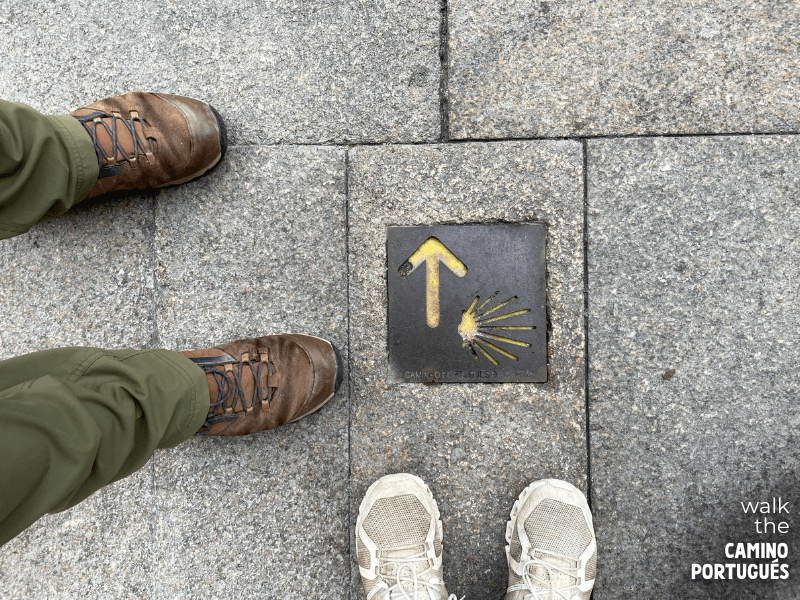
Camino waymarker outside of the Porto Cathedral (Sé do Porto) 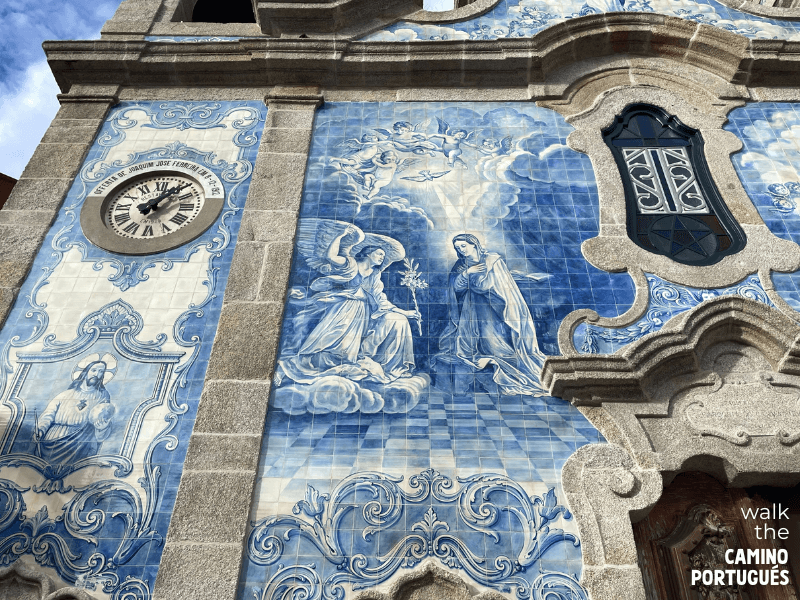
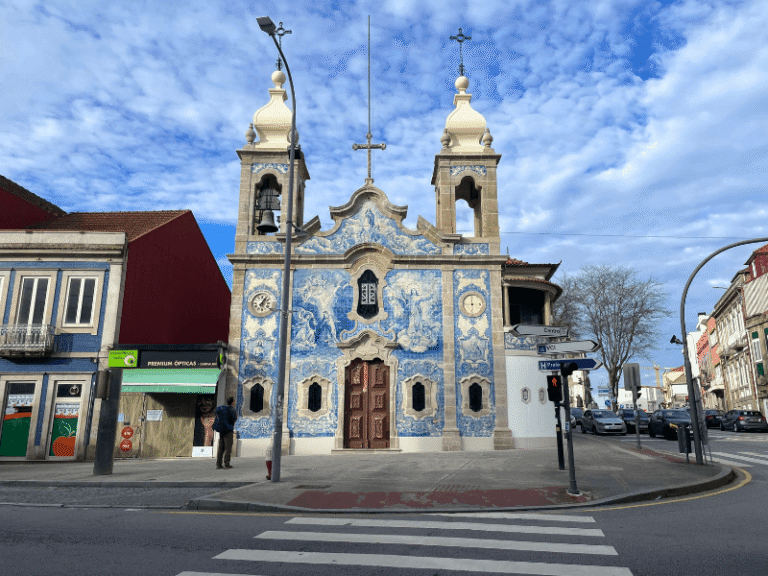
Up-close look at the azulejos on the Igreja do Sagrado Coração de Jesus in Porto 
Cruzeiro do Padrao da Legua, 17th century stone cross depicting the crucifixion of Jesus 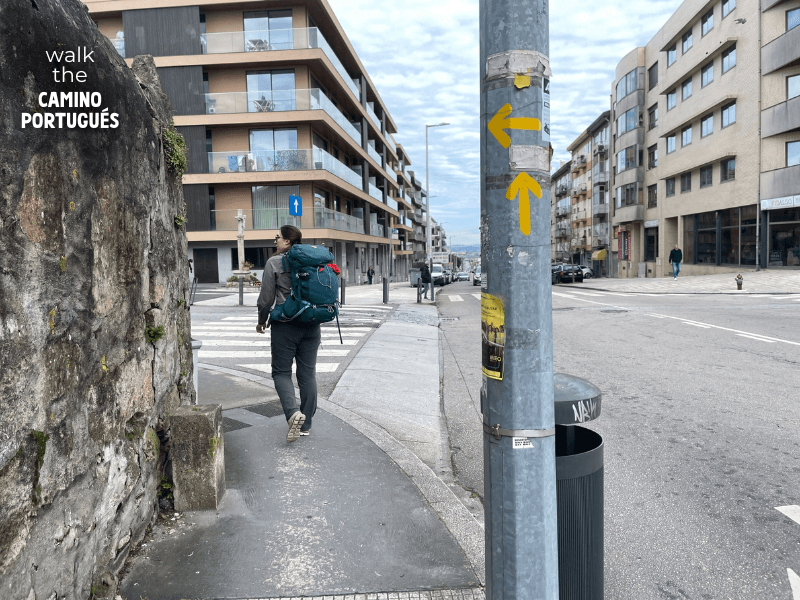
Pilgrim walking along the Camino Custóias (greater Porto area) where the Coastal Route splits from the Central Route 
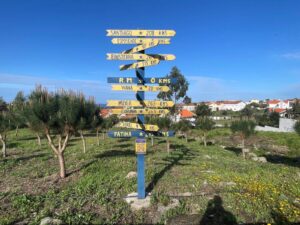
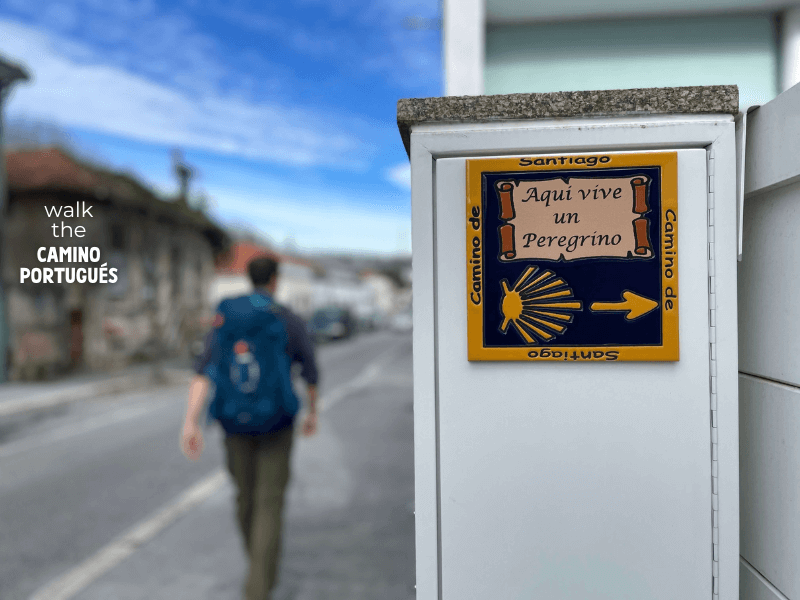
Camino art/signage along the Coastal Camino Portugues 
Camino marker in front of the Largo do Souto (square) 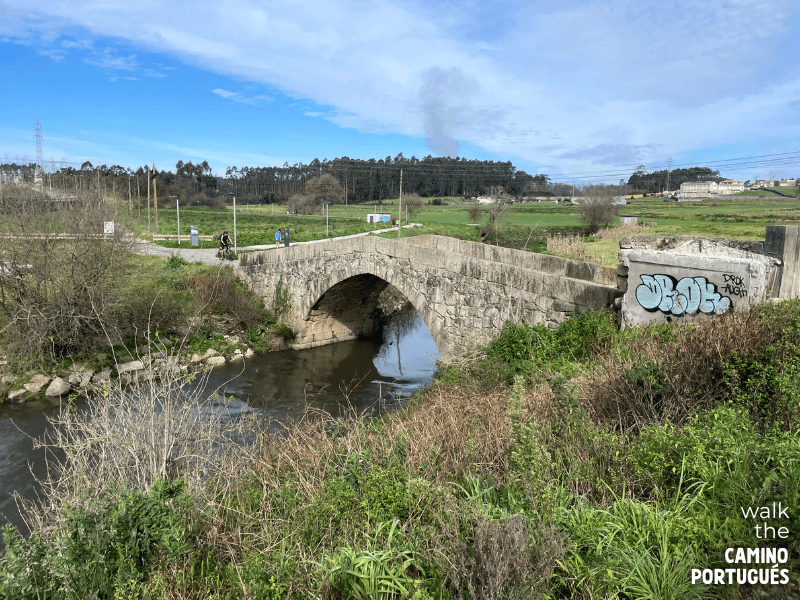
Ponte de D. Goimil, a pointed arch bridge with characterics pointing to the Middle Ages, over the Leça River 
Pilgrim walking past a historic stone cross at Vila Nova da Telha 
Two pilgrim backpacks leaning against the wall of the Parish Church of Vila Nova da Telha 
Pilgrim walking on cobblestones past the Porto Airport 
Small road and fence along the Porto Airport 
Yellow arrow and Camino marker along the Coastal Route 
Yellow flower (Common Broom) along the Camino Portugués 
The Igreja de São João Evangelista in Mindelo 
Cobblestones on the Coastal Route 
Blossoming tree along the Coastal Route 
Sunset along the Coastal Route with a glimspe of the Atlantic Ocean in the background 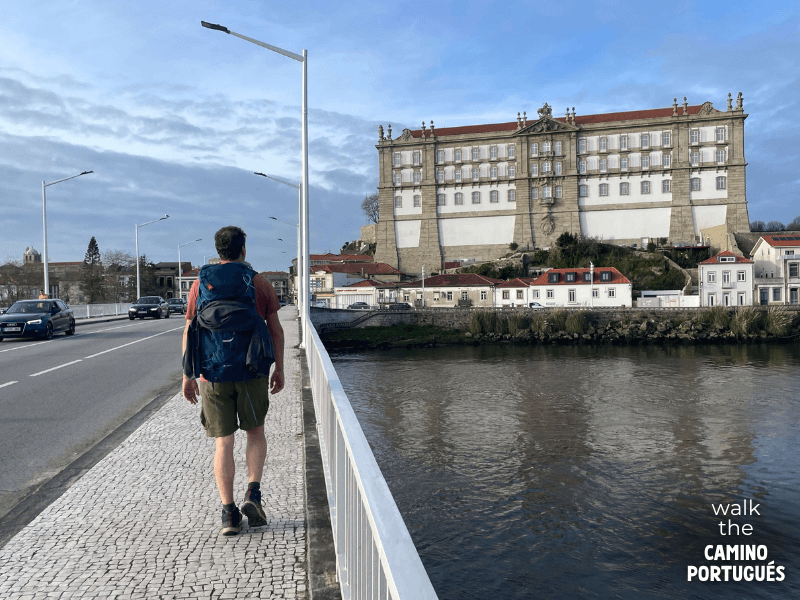
PIlgrim walking across the bridge into Vila do Conde with the Santa Clara monastery in the background 
pilgrim walking underneath the bridge next to the Ave river on the Coastal Route 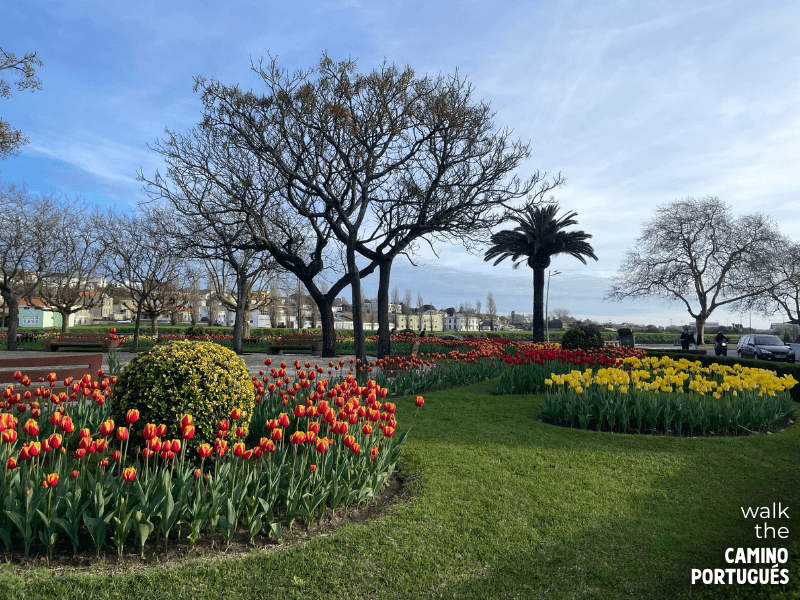
Little park on the Praça da República in Vila do Conde 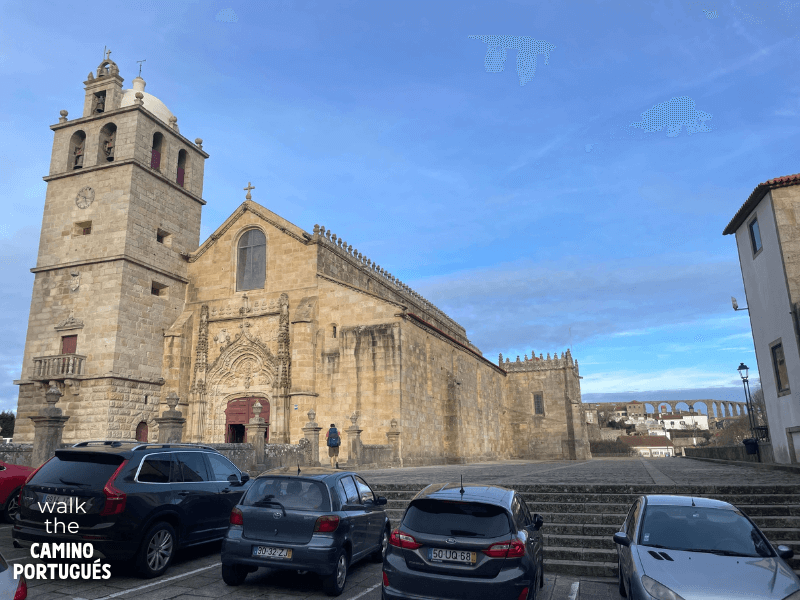
The Igreja Matriz de São João Baptista in the center of Vila do Conde on the Coastal Route of the Camino Portugués 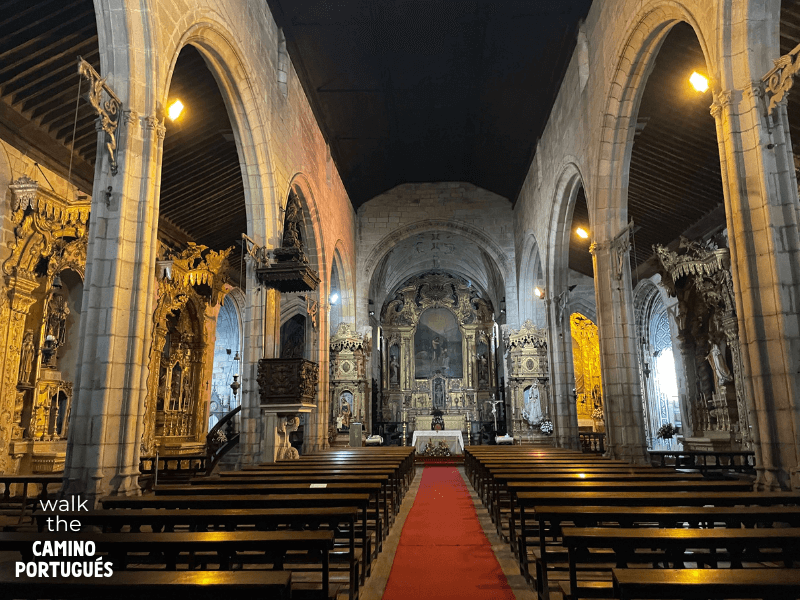
Interior of the Igreja Matriz de São João Baptista in Vila do Conde
Map
For our map, we chose to start walking from the Sé de Porto and ended at the tourism office in Vila do Conde. The cathedral is the official starting point of the Coastal Route, and you can get your pilgrim’s passport as well as your first stamp there.
If you want to skip or fast-forward through the first section through Porto, find the Cruzeiro do Senhor on Google Maps. This is where the Coastal Route breaks off from the Central Route; it should be about 1 km after a Lidl.
We chose to end this stage of our journey at the tourism office in the center of Vila do Conde. The people will give you a stamp and happily share plenty of tips and advice for the rest of the journey.
Distance and Elevation*
Distance: 28.4 km / 17.65 miles
Elevation gained: 354 meters / 1,161.42 feet
Elevation lost: 404 meters / 1,325.46 feet
*Distances are estimates. Learn why on our methodology page.
Amenities
Throughout the first stage, you can benefit from all the amenities in Porto. For the first half of the stage, cafes and restaurants are never far away.
However, the situation changes once you approach the Porto Airport. The scenery becomes more rural, and amenities become more sparse (but never more than a little). Fortunately, the stage passes through several small towns where you can find a cafe and a bathroom if necessary.
For your first day, consider stopping at Lidl Monte dos Burgos. In this supermarket, you can get your supplies for the day as well as some delicious coffee and pastries.
About 7,5 km before you reach Vila do Conde, close to Vila Cha, there’s the welcome shopping center of Vila do Conde Retail Park. Stop here if you need bathrooms, restaurants, or a supermarket.
The small town of Vila do Conde has several supermarkets and minimarkets to stock up for the next day. In addition, there are plenty of restaurants and cafes where you can recharge.
What’s in Store?
The Coastal Route starts with the longest first day of any of the Camino Routes. Although technically the Senda Litoral is longer, most pilgrims stop earlier in Matosinhos or Vila Cha.
On your first day, you’ll leave the beautiful city of Porto and make your way to the Atlantic Coast. You’ll pass through several smaller towns, which give the second half of the day a less urban feel.
Unfortunately, today also marks your introduction to one of the most challenging features of the Camino Portuguese: cobblestones. These uneven little stones may look incredibly charming at first, but they will soon become a major issue as walking on them becomes increasingly uncomfortable.
When you first arrive in the UNESCO World Heritage city of Porto, there’s so much to see! First, there are architectural highlights such as the Cleric’s Tower and São Bento Station. And of course, there are so many new foods and ports to try.
Historic Fact: Despite the medieval architecture, the Coastal Route of the Camino Portugués has been an official pilgrim route for less than 30 years. The Central Route has been around since medieval times, but the Coastal Route only became an official route in 2009!
Portugal is off to a great start! It’s almost easy to forget you have some walking to do. So finish your breakfast and get ready for a big day.
Morning: Leaving Porto
The Coastal Route starts in front of the cathedral, from where you have stunning views over the Douro River. If you don’t have it yet, you can get your pilgrim’s passport at the gift shop here.

Before you go, take a moment to appreciate where you are! Look for the historic port warehouses, churches, and bridges that make this city such a gem. If you’re lucky enough to be there at sunrise, the early morning sun gives the scene an almost magical feel.
The first hour or so, you’ll walk through the beautiful city center of Porto on the main road of the Camino Portuguese. While road walking is a major part of the day, the presence of sidewalks never makes you feel uneasy.
After you pass the two supermarkets Lidl and Continente, you’re getting close to the Cruzeiro do Senhor. This historical cross marks the point where the Coastal Route breaks away from the Central Route. Where the Central Route goes inland to Vairão, the Coastal Route goes west towards the coast.
As you’re walking, keep your eyes out for signs of the history of the route. Many of the blue-tiled churches or squares on the route are connected to the pilgrimage, and they often list this information on signs or plaques.
Continue walking through a small park, and then it’s back to the road. As you’re walking, you may notice that planes are flying over increasingly lower. This is a sign that you’re approaching the Porto airport and that you’re just shy of the halfway point for the day.
Afternoon: Pedras Rubras and the Airport
Now that you’ve been walking for a few hours, it feels like the hustle and bustle of Porto is a distant memory.
Overall, houses will have a more suburban feel as the taller buildings of Porto give way to smaller houses with more green space. Everywhere you go, you can see orange and lemon trees that add some lovely specks of color to the landscape.
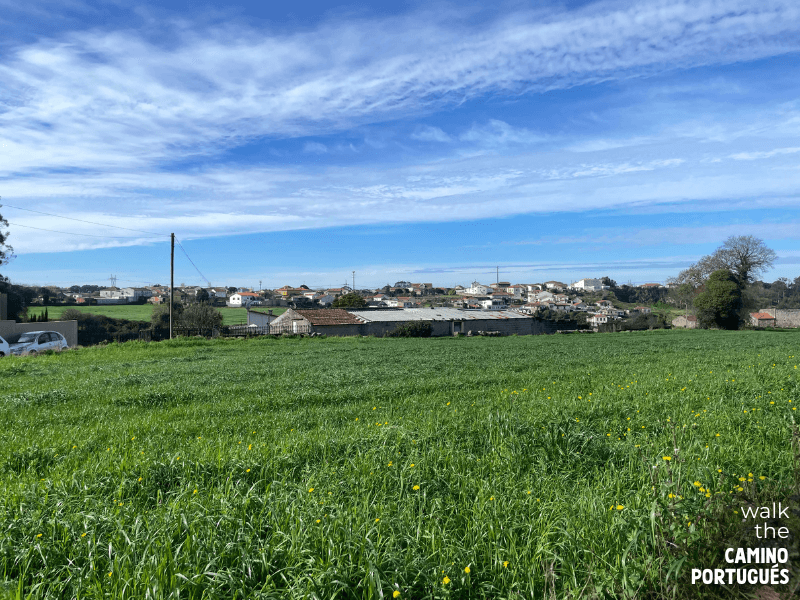
As you’re approaching the Francisco Sá Carneiro Airport, the scenery becomes a little more urban and industrial. Fortunately, it’s only for a moment and you’ll be back among the farms and suburbs in no time.
Continue past the local football stadium and before you know it, you’ll catch your first glimpse of the coastline! As you’re approaching Vila do Conde, views of the sea coast will become more and more common.
Arriving in Vila do Conde
The walk from Porto to Vila do Conde makes for a long first day on the Coastal Route. It’s not surprising that many pilgrims breathe a sigh of relief when they see the bridge that is the entrance into town. While you might be tired and just want to collapse into your bed, don’t miss out on this Portuguese gem!
One of the first things you see when entering Vila do Conde is the imposing Santa Clara Monastery. Although the monastery is no longer in use, the grounds with neighboring medieval church are well worth a visit.
Vila do Conde has plenty of historic sights that highlight its strong connection to Portugal’s seafaring past. If you have the time, I recommend walking up to see the amazing replica of the Nau Quinhentista. Seeing how small it is, it’s hard not to admire the courage of the people who crossed the Oceans in these ships!
A little further down, you can spot the Capela de Nossa Senhora do Socorro. The appearance of this odd-looking 16th-century church was inspired by sights that sailors saw in the Orient!
Accommodations
There are plenty of options available to the weary pilgrims. Vila do Conde has many accommodations and is sure to have something for pilgrims of all budgets.
In the heart of town, you can find the local albergue Santa Clara. This albergue is a no-nonsense version of the type of accommodation that you can expect on the Camino. It has all the basic facilities such as a kitchen, laundry services, bunk beds, and a nice communal dining area.

If your budget allows for a bit more, I recommend trying out the Pousada de Juventud. This hostel offers great double rooms that are a step up from the often crowded albergues.
For people looking for a bit more comfort and private rooms, the conveniently located Venceslau Wine Boutique Hotel. This hotel offers comfortable rooms with private bathrooms that are great value for money.
Keep in mind that Vila do Conde is a popular beach destination for people from Porto. This means that cheap accommodations book up during the summer months. Make sure to book in advance so you can go straight to bed upon arrival instead of having to find a place to sleep.
Extending or Shortening the Stage
While walking from Porto to Vila do Conde is the first official stage on the Coastal Route, it’s definitely not your only option. The stage is long, and there are several options to consider if you’re looking for a shorter day.
Some pilgrims prefer to walk short stages to take it all in, while others decide to attempt the physical challenge of 40 km days. Whatever you choose, you’re good as long as you eventually reach Santiago!
Longer Stage: Póvoa de Varzim
For pilgrims wanting to extend the first day, consider walking to Póvoa de Varzim. This adds about 5 km to your day, making it 33 km in total.
The extra kilometers make for a lovely walk on a coastal boulevard towards the next town. While you won’t walk on boardwalks, it is a beautiful walk with plenty of amenities and cafes. Póvoa de Varzim is a nice beach town with a cute town square and plenty of places to stay.
Vila Chã
Vila Chã is a popular stop with pilgrims walking from Porto to Vila do Conde on the Senda Litoral. Stopping here shaves about an hour and a half off your first day.
Although Vila Chã is not directly on the Camino, it’s about a 25-minute walk from the route. After you reach the Vila do Conde Retail Park, turn left, and you’ll soon see it. The town has several places to eat and even boasts its own albergue, the Albergue São Mamede.
Árvore
This town is one of the hidden gems on the Camino Portuguese. With several small supermarkets, restaurants, and a quiet beach, this town has everything you need after a long day’s walk.
We stayed at the Host Wise Árvore in April and still consider it one of the highlights of the entire trip. This simply incredible accommodation is less than 5 minutes from the beach and offers large rooms with private bathrooms and a well-equipped kitchen. There’s even a jacuzzi on the terrace!
Árvore is conveniently located near the metro station and has an easy connection to Vila do Conde. Useful to know in case the albergues in Vila do Conde are full.
Crossing Over to the Central Route
Despite being part of the Coastal Route, Vila do Conde is a popular first stage for pilgrims heading to Santiago on the Central Route. Since the walk out of Porto on the Central Route is not exactly a pleasant hike, many pilgrims choose to start on the Litoral or the Coastal Route before crossing over.
While you can certainly take a taxi or even a bus you can take, most pilgrims prefer to walk the roughly 13 km to São Pedro de Rates. From there, it’s about 17 km more to Barcelos.
If you want to take the bus, the easiest connection is from Póvoa de Varzim to São Pedro de Rates. Keep in mind that the local buses are often not listed on apps like Omio or Rome to Rio. Instead, find the local bus schedule here.
¡Buen Camino!
And just like that, you’ve completed your first day on the Camino Portuguese!
I really hope that your feet are in good shape, your pack wasn’t too heavy, and most importantly, that you had a good time on the Camino.
Tomorrow’s stage is less roadwalking and more beaches and boardwalks.
¡Buen Camino!