As an Amazon Associate, I earn commission from qualifying purchases.
After the long day out of Porto, today’s stage from Vila do Conde to Esposende is a breeze. With a distance of slightly under 24 kilometers, you’re in for a nice and easy day.
Since you’re walking next to the Atlantic Ocean for most of the day, there will be plenty of opportunities to eat breakfast or have a quick café con leite (coffee with milk) at one of the many restaurants and cafes.
All in all, an exciting new day on the Camino Portuguese!
Save it for later! ↓

Quick links:
- Coastal Route Overview
- Yesterday’s stage: Porto to Vila do Conde
- Tomorrow’s stage: Esposende to Viana do Castelo
Vila Do Conde To Esposende (Coastal) Overview
Experience Today’s Walk
☑ See the fishing boats sailing into Vila do Conde (if you wake up early enough!)
☑ Taste the salty air on the boardwalks next to the Atlantic Ocean
☑ Hear the crashing waves and seagulls on the rockier parts of the coast
☑ Touch Feel the wooden planks on your first stretch of boardwalks
☑ Smell the fresh coffee and pastries from the bakeries on the promenade in Póvoa de Varzim
Today is a relatively easy stage with little to no elevation and a nice variety in surfaces to walk on. The terrain goes from a charming promenade in Póvoa de Varzim to boardwalks with beautiful views of the Atlantic Ocean. While a significant part of the stage takes you on nice surfaces, the day is not without cobblestones.
On your way to Esposende, you’ll see plenty of beaches with old windmills as well as cute fishing towns. Everywhere you look, you’ll see signs of Portugal’s deep connection with the sea, whether it’s fishing or exploring.
Finally, walking into Esposende feels a lot longer than it is. You cross the Rio Cávado (Cávado River) on a beautiful metal bridge, and although it feels like you’re almost there, you still have quite a bit of walking ahead of you.
All in all, a nice day, but when I walked this stage, I was surprised by how tired my feet were at the end of it!

Azulejos scene along the Coastal Route of the Portuguese Camino 
Camino de Santiago sticker on the window of a restaurant along the Coastal Route 
Praça do Almada in Póvoa de Varzim along the Coastal Route 
Capela de São Roque on the Coastal Route in Póvoa de Varzim 
Pilgrims walking on the beach in Póvoa de Varzim 
Small Camino sign nailed to the boardwalk out of Póvoa de Varzim on the Coastal Route of the Camino Portuguese 
Pilgrim sign painted on the side of a building outside of Póvoa de Varzim on the Coastal Route 
A pilgrim’s backpack on the wooden boardwalk on the Coastal Route 
White wall outside of the Estela Golf Club between Vila do Conde and Esposende on the Coastal Route 
Shrine to Saint James with pilgrim souvenirs on the Camino Portuguese 
Decorative tiles on the Coastal Route of the Portuguese Way 
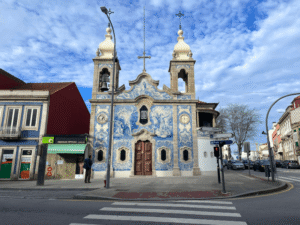
Characteristic Portuguese church in Apúlia 
A Camino sign and a pilgrim who crosses the road 
A pilgrim standing in front of the Igreja do Senhor Bom Jesus de Fão on the Portuguese Camino da Costa 
A sign telling pilgrims there is a stamp inside on the Portuguese Camino 
A pilgrim admiring the interior of the Igreja do Senhor Bom Jesus de Fão 
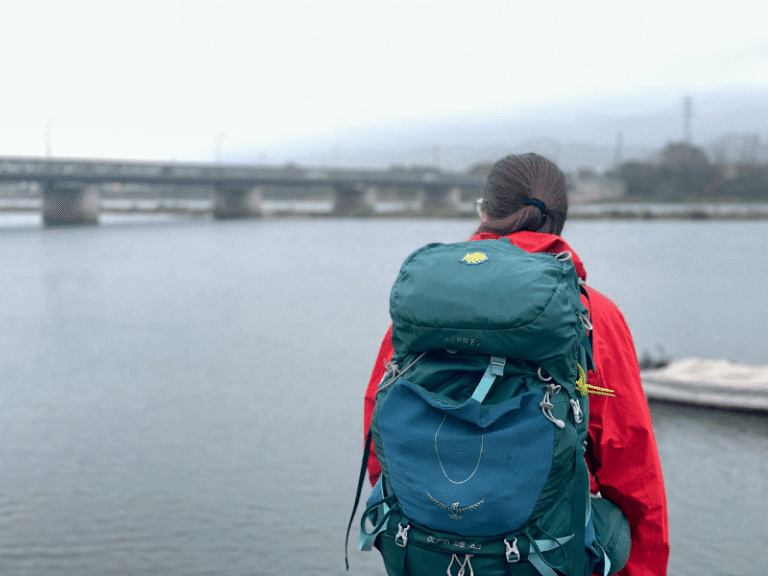
A pilgrim walking along the river Cávado towards the Ponte metálica de Fão on their way to Esposende on the Coastal Way 
Statue of a Camino shell at the entrance of Esposende on the Coastal Camino 
A decorative street tile with a sigla poveira in Esposende on the Coastal Route
Map
Our map starts at the Tourism Office in Vila do Conde. The Tourism Office is right next to the Coastal Route of the Camino and a local albergue.
Likewise, the GPS track for our route ends at the Tourism Office in Esposende, only a block away from the center of town.
Distance and Elevation*
Distance: 23.7 km / 14.73 miles
Elevation gained: 167 meters / 547.90 feet
Elevation lost: 170 meters / 557.74 feet
*Distances are estimates. Learn why on our methodology page.
Amenities
For most of the day, amenities are never far away. The early part of the stage takes you through Póvoa de Varzim, a popular holiday destination for families that come from Porto. While this means amenities everywhere, it also means crowds in the summer months!
Walking from Vila do Conde to Esposende, you’ll also find your first stretches with limited amenities. This is primarily because bars and restaurants change their opening hours with the tourist seasons. Especially after Póvoa de Varzim, many amenities have limited opening hours, and some might even be closed during the winter months.
After the Estela Golf Club, I hope you’ll stop at the Casa do Moinho for a nice cup of coffee. The Peruvian owner is very chatty and even has a bed available for pilgrims looking to spend the night.
With two big supermarkets and plenty of restaurants, bars, and cafes, Esposende has everything you need. One of my favorite Camino memories is sipping a glass of Vino Verde on the little square in front of Pizzeria di Pappi while my clothes were in the laundrymat. Life is good on the Camino!
Although you’ll never find yourself in a food desert, it’s best to use amenities when you see them if you’re walking during the low season.

What’s In Store?
After yesterday’s stage out of Porto, this stage feels significantly more outdoorsy. Instead of the hustle and bustle of a big city, you’ll spend most of the day walking between small fishing towns.
Today is a lovely walk through a variety of landscapes. On this second stage, you’ll find yourself on boulevards, cobblestone streets, and even on the occasional stretch of forest path. For large parts of the day, you walk next to the Atlantic Ocean before moving inland later in the afternoon.
Starting in Vila do Conde, the Camino is exceptionally well-marked, with no chance of getting lost. Every time you need to make a turn, you’ll find the familiar yellow arrows pointing you in the right direction.
That being said, don’t be surprised to see pilgrims completely miss or ignore the arrows. For a significant part of the day, the Coastal Route and the Senda Litoral overlap. When you see pilgrims taking a different path, it just means that they’re on the Litoral Way.
As you’re walking, keep an eye out for cute historic shrines and churches along the coast. They’re often dedicated to Saint Peter or Nossa Senhora da Agonia (Our Lady of Agony), the patron saint of fishermen.
Morning: Vila do Conde to Póvoa de Varzim
Today’s stage starts in Vila do Conde and immediately passes by the Igreja Matriz de São João Baptista. This beautiful church is worth a visit as it dates back to the late 15th century, and it’s connected to the Camino de Santiago. King Manuel I of Portugal stayed here on his pilgrimage to Santiago de Compostela.
When leaving Vila do Conde early in the morning, you can see that it’s still very much an active fishing town. You’ll see fishermen come in with their catch for the day to be sold at local markets.
More than anything, leaving Vila do Conde is about seeing the Atlantic Ocean from a distance. For the first hour or so, you’ll see the ocean down the road, but you’re always a block away. It’s not until about an hour in, at the next town of Póvoa de Varzim, that you walk next to the beach.
Historic Fact: Did you know that fishermen in Póvoa de Varzim used their own symbols, called Siglas Poveiras, to mark their boats and property? These cool signs and sigils go back centuries and may even be derived from Viking Runes. Can you spot all of them?
Once you reach Póvoa de Varzim, the Camino route becomes a lovely, wide boulevard. If you’re walking in sunny weather, make sure to apply plenty of sunscreen as there won’t be any shade for the next few hours.
In my experience, people are incredibly welcoming to pilgrims on this stage. I have walked this section several times and I’ve run into friendly locals every time. Don’t be surprised if someone pats you on the shoulder, shows you heart-hands, or wishes you a ‘Bom Caminho‘!
Afternoon: Aguçadoura and Apúlia
A little after 10 kilometers of boardwalks and cobblestones, you reach the town of Aguçadoura. Especially on hot days, the amenities in this town are a welcome sight for most pilgrims. Summer offers a nice vibe as it is also the time when surfers come from all over the world to ride the waves.
After the town, you’re presented with a choice. When you arrive at the car park, you can either follow the boardwalks past the football club or turn right and merge with the M501 road.
Since this is the Coastal Route, we decided to continue walking on the boardwalks for a little longer, past the Estela golf course. Given that both routes merge onto the M501 eventually, there really isn’t a right or wrong choice here.
Between Aguçadoura and Apúlia, the scenery changes. Beaches and boardwalks become farmland and forests where the shade from the trees offers a welcome break from the sun.
When you reach Apúlia, the beautiful church Igreja Matriz de Apúlia is a nice place to rest. The church has a nice stamp available and I felt especially grateful for the public bathrooms that are just around the corner!
Once you leave town, Esposende is not far away.
Arriving in Esposende
The small town of Fão is located on the Cávado River just before Esposende. While its amenities are nice, you may want to continue your journey since your destination for the day is less than half an hour away.
In town, take a moment to visit the Igreja do Senhor Bom Jesus de Fão. This is a beautiful church with interesting signs explaining its connection to the Camino Portuguese. From here, you can also see the bridge that will take you across the river into Esposende.
Once you cross the bridge, you’re welcomed by the biggest yellow arrow on the entire Camino. Although you can already see the first houses of Esposende, don’t get too excited, as it will still be a few minutes until you arrive. Fortunately, the route is very well-marked, and it’s just a matter of following the side road.
Accommodations in Esposende
The town of Esposende is a true pilgrimage town with several excellent accommodation options for pilgrims. Although it may be tempting to stop for the night at one of the places you see just across from the bridge, continue walking until you reach the actual town itself for the best options.
Located one block from the Litoral Way is the excellent Esposende Guesthouse. With beautiful private rooms as well as comfortable bunk beds in dormitories, this place is hands down one of my favorite stays on the Camino. It has a large kitchen and dining area, and the owner even lights the fireplace on colder days!
If the Esposende Guesthouse is fully booked, consider the Hostel Eleven Esposende. This simple but comfortable hostel offers bunk beds and is conveniently located on the Coastal Route. Although the rooms are shared, each bunk has a small curtain that still offers some privacy.
Finally, the Inn Esposende Sports Hostel is a great option if you’re looking for some comfort after two days on the Camino. With comfy rooms and beds as well as options for bike storage, this hotel is a place to consider for pilgrims headed for Santiago on wheels.
If you plan to walk during peak season, it’s a good idea to book ahead. While there are plenty of budget accommodations available, they’re not exclusive to pilgrims and tend to book up. After a long day of walking, you just want to put down your pack. The last thing you want is to have to spend a long time trying to find a place to sleep!
Extending or Shortening the Stage
The stage to Esposende feels a lot longer than it really is, and many pilgrims choose to continue walking to the next town.
Longer Stage: Marinhas
If you feel like walking a little longer, then the small town of Marinhas is basically 4 kilometers down the road. With nice views of the coast and with sights like the imposing Forte de São João Baptista, the scenic walk lets you shave off about an hour of tomorrow’s stage to Viana do Castelo.
In Marinhas, you have several options for finding a place to sleep as well as a mini supermarket.
Shorter Stage: Fão
As you walk towards Esposende, you’ll walk through Fão. While most pilgrims choose to end their stage in Esposende, this little town is a very nice stop for people reaching their distance limit for the day.
With some cute riverside restaurants as well as plenty of places to stay, Fão is worth considering as a destination for this stage.
¡Buen Camino!
After a day of beaches and boardwalks, the Coastal Route goes inland tomorrow. Expect stunning coastal views and your first taste of elevation!
¡Buen Camino!