As an Amazon Associate, I earn commission from qualifying purchases.
With the walk from Vigo (population 294,000) to Redondela (population 29.192), we have reached the last stage of the Portuguese Coastal Camino. From here, both the Central Route and the Coastal Route share the last 5 stages to Santiago de Compostela.
When I was on my first Camino, the beautiful views of the coast and the Vigo estuary made this my second-favorite stage of the whole Portuguese Coastal Way. (My first one was leaving the cathedral in Porto!)
Let’s look at what this exciting final day has in store for pilgrims!
Save it for later! ↓

Quick links:
- Coastal Route Overview
- Yesterday’s stage: A Ramallosa to Vigo
- Tomorrow’s stage: Redondela to Pontevedra
Vigo To Redondela (Coastal) Overview
Experience Today’s Walk
☑ See the stunning Rande Bridge that crosses the Vigo Estuary
☑ Taste Llaneras, a traditional dessert with almonds and butter cream that originated in Vigo!
☑ Hear the hustle and bustle of the first true city after Porto
☑ Touch dip your weary feet in the cool stream when you reach the waterfalls at Rego Fondón
☑ Smell fresh coffee and pastries from one of the many bakeries in Vigo
On the final stage of the Coastal Route, the Camino takes you through some of the most stunning scenery of the Camino. With beautiful forest trails as well as stunning coastal vistas, this is a short stage that packs a major punch.
At the beginning of the day, the road is still paved, but later it turns into a lovely dirt path. It’s really nice to walk on, but it can be slippery when wet. One of the fun highlights is the pilgrim rest area next to the small waterfall at Rego Fondón. I loved putting my feet in the water and chatting to fellow pilgrims.
Once you’re out of Vigo, you’ll notice an almost snake-like yellow line on the road that the Camino seems to follow. This is part of a different trail called the Senda del Agua, which goes from the Eiras reservoir to Vigo.
Although you’re spending most of the day walking above towns, the elevation doesn’t pose much of a challenge. While leaving Vigo is a bit of a slow burn as you walk up to the trail, the rest of the day is spent walking on mostly flat surfaces. This day on the Portuguese Camino ends with a pretty steep descent into Redondela.

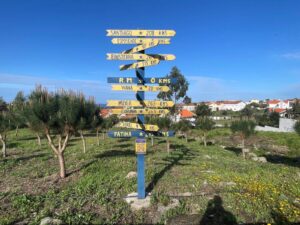
Scallop shell Camino waymarker sign in Vigo showing 101 km until Santiago 
Pilgrim signage in Vigo’s city center 
A pilgrim walking up a steep hill leaving Vigo 
Dirt path with two cyclists and purple flowers hanging over the wall on the Coastal Route out of Vigo 
Waterfall at Rego Fondón on the Coastal Route of the Camino Portugués 
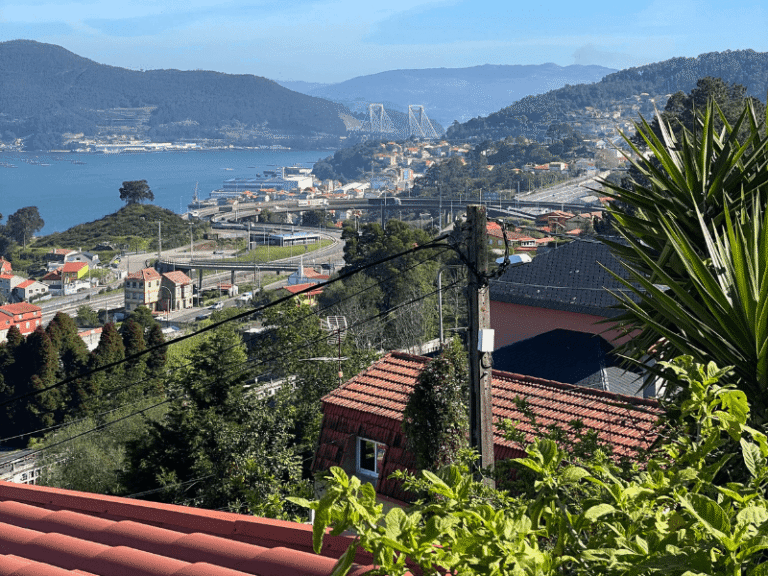
View on the Coastal Route of the Vigo estuary with the Ponte de Rande in the background 
The Ponte de Rande and the Vigo estuary on the Coastal Route 
Looking down on Vigo and the Vigo estuary on the Coastal Route towards Redondela 
Ponte de Rande through trees in a forest on the Coastal Route of the Camino Portugués 
Group of pilgrims in lush green path on the Coastal Route of the Camino Portuguese
The End of the Portuguese Coastal Camino
Once you reach Redondela, you will completed the Coastal section of the Camino Portugues. From here on, you’ll have to share the road with the pilgrims who walked the Central Route out of Porto.
You may already notice a significant increase in the number of fellow pilgrims on the Camino. Vigo is one of the most popular starting points for any pilgrims looking to walk the last 100 kilometers to Santiago de Compostela.
Many pilgrims notice a change in the nature of the Camino after Redondela, and it’s not always for the better. The increased number of pilgrims on the road will probably take some getting used to.
Personally, I am drawn to the quieter parts of the Camino where you meet a few pilgrims on the road, and each interaction feels more meaningful. After Redondela, there will be more fellow pilgrims, which can make the trail feel crowded.
Map
This is a short stage. Our map starts next to the Vigo train station and ends under the aqueduct in Redondela.
Distance and Elevation*
Distance: 15.6 km / 9.70 miles
Elevation gained: 345 meters / 1,131.89 feet
Elevation lost: 363 meters / 1,190.55 feet
*Distances are estimates. Learn why on our methodology page.
Amenities
While you won’t have any trouble finding breakfast in Vigo, amenities are scarce once you leave town. Although you start in the largest city in Galicia, you’ll find that most of the stage takes you around towns rather than through them.
About two-thirds of the way in, you’ll come across the charming O Eido Vello Cabanas. This is one of the few places where you can stop for a drink on this stage.
While much of the Portuguese Camino can be walked rain or shine, this is a day where you should pay attention to the weather conditions. Bring plenty of water on hot days!
What’s In Store?
Today is a short day but with a significant climb at the beginning, it can seem a lot more challenging than it is.
No matter if you took the Senda Litoral or the Coastal Route into Vigo, taking the main road out means going up, a lot! The moment when the Camino levels out comes as a welcome relief, and for most of the day, the road is more or less flat until you reach Redondela.
Many pilgrims notice that the nature of the trail changes when you enter the heartland of Galicia. You’ll find that churches are now dedicated to Saint James and the road is increasingly flanked by stone crosses that mark the historic road to Santiago de Compostela.
As you make your way to the final destination, you’re no longer just walking. What was once a simple journey on foot has become a pilgrimage.
Morning: Leaving Vigo and a Small Waterfall
The yellow arrows that are so common on any of the other stages of the Camino de Santiago are not as prevalent in Vigo. This is why you really need a navigation app or even a physical map to find the Camino Route.
Once you find your way from the Rúa de Ursaiz to the Rúa de Toledo, you’ll see the arrows again. It’s a moment to appreciate how well-marked the Camino de Santiago is. Having to get your phone out constantly is no fun!
It won’t be long before the hustle and bustle of town is replaced by the calm of forests and gravel paths. The tranquility of the green surroundings makes you quickly forget the urban start of the day.
While you’ll see plenty of little streams and tiny waterfalls, one of my favorite moments on the first part of the trail was the small waterfall at Rego Fondón. Not only is it a great place for a break, but it’s also a popular resting point for pilgrims, making it the perfect opportunity to swap some stories while cooling your feet.
Afternoon: Cabanas and the Vigo Estuary
The moment you’re out of Vigo, you get to look back for some stunning views of the Rande Bridge and the Vigo Estuary. For most of the afternoon, pilgrims are treated to views that seem to get better and better.
In addition to the scenic beauty, the Vigo Estuary is the subject of some interesting legends. In 1702, a Spanish galleon laden with treasure from the New World was sunk here. Although the treasure has never been found, rumors of treaure buried in the seabed remain popular to this day.
Historical fun fact: The treasure is the source of many local legends and has even made it into literature. In the novel 20,000 Leagues Under The Sea, Jules Verne states that Captain Nemo used the treasure to build his famous submarine Nautilus!
When I walked this stretch, I only saw a single bar on the entire stage until I reached Redondela. In the town of Cabanas, you can find the super charming bar O Leido. Even though it’s not directly on the Camino, there’s a big sign pointing you in the right direction.
From here it’s only a little bit further until you reach the end of the plateau. After another beautiful viewpoint, you start the final stretch into Redondela.
Arriving in Redondela
Redondela is located on the Ría de Vigo and you can see itin the distance pretty soon after you leave the city. At the end of the day, pilgrims have to go down a series of hairpin-like roads that make up the steep descent into town. Be careful on these streets!
Slowly, the forests give way to urban areas as you walk into Redondela, and it won’t be long before you spot one of the defining landmarks of the town, the viaducts. Built in the 19th century, they can be seen from almost anywhere in town.
The heart of the city is around the Alameda de Castelao, a beautiful park along the Río de Redondela. With plenty of local restaurants and bars as well as nice views on the Viaduto de Pontevedra, it is the perfect place to enjoy the slow end of your day.
Once you reach the old city center, you will see the first effects of the increase in pilgrims on the road. This is the first time you’ll meet the pilgrims who decided to leave Porto on the inland route of the Camino. If you’re curious, it’s a fun time to strike up a conversation and hear some stories about the ‘road not taken’!
Accommodation Options
Redondela is a mid-sized city that has several options availabe to pilgrims. It has several (private and municipal) albergues as well as hotels for every budget.
On my first few Caminos, I always stayed in a budget hotel, Pensión Santa Clara. Staying here for the night gets you a comfortable room that is excellent value for money. With a location very close to the Camino, it’s hard to beat this place!
Pilgrims looking for the albergue experience can choose to stay overnight at the Albergue Santiago de Redondela or at the official Albergue de Peregrinos Casa de Torre. Both albergues offer basic amenities such as laundry service and a kitchen.
My favorite albergue, A Dársena do Francés is in Cesantes which is a little bit beyond the center of town. I loved staying here becuase of the real sheets that you get as well as the fact that a stay here comes with breakfast. But most improtantly, this albergue has comfy rooms that come with AC!
Extending or Shortening the Stage
Since the walk from Vigo to Redondela is such a short walk, many pilgrims that walk the Coastal Route choose to walk a little further.
Redondela has plenty to offer in terms of amenities but it’s far from my favorite town on the Portuguese Camino de Santiago. Tomorrow’s destination has much more to offer and it’s better to walk a little further today in order to leave some time for exploration tomorrow.
Finally, in Redondela you will meet the pilgrims that decided to take the inland route out of Porto. Most pilgrims will stay in Redondela and leave at roughly the same time in the morning. Getting a bit of a head start is the best way to avoid an overly-crowded trail.
Longer Stage: Cesantes
The small town of Cesantes is about 2 kilometers past Redondela. While there is little to see here, you have all the basic amenities at your disposal.
Staying at A Darsena do Francés or one of the other accommodations here means you have all the basic amenities covered. Breakfast, restaurants and even a supermarket are all just a few minutes away.
As you walk out of Redondela, don’t forget to stop at the Chapel of Saint Mariña for a nice stamp. It’s located just after the roundabout on the street Rúa da Picota, right next to the N-550.
Longer Stage: Arcade
On the stage from Vigo to Redondela, distance is not really an issue. Walking to Arcade adds about 7 kilometers which makes the total stage about 23 kilometers long.
The small town of Arcade is one of the highlights of the Camino in Galicia. While it may not seem like much at first, keep walking until you reach the stunning medieval bridge of Pontesampaio and you’ll see why!
In Arcade, consider staying at the Albergue Lameiriñas. With a communal kitchen, laundry service and AC, this private albergue is a great place that is close to the the main sights.
The Last Stages of the Camino de Santiago
Whether you took the Central Route, the Coastal Route or the Senda Litoral, the different routes come to an end in Redondela. Even though the bulk of the Portuguese Camino is now behind you, there is still plenty to look forward on the last section of the way to Santiago.
Like the Camino Francés, signs of the ancient roots of the pilgrimage to Santiago de Compostela are all around you. Churches are dedicated to Saint James and most of the road is lined with old and worn stone crosses. You can even find a few medieval monasteries that still take in pilgrims!
When I walked the last section for the first time, I loved the feeling of getting closer to Santiago. There was a unique feeling of excitement in the air that was shared by the pilgrims I met.
Buen Camino
There are still so many things to see and experience on the final days of the Portuguese Camino de Santiago!
If you came from one of the calmer Camino Routes, I hope you won’t struggle as much with the changes as I did. Keep in mind that with more pilgrims on road come more opportunities for meaningful connections and stories.
Buen Camino!